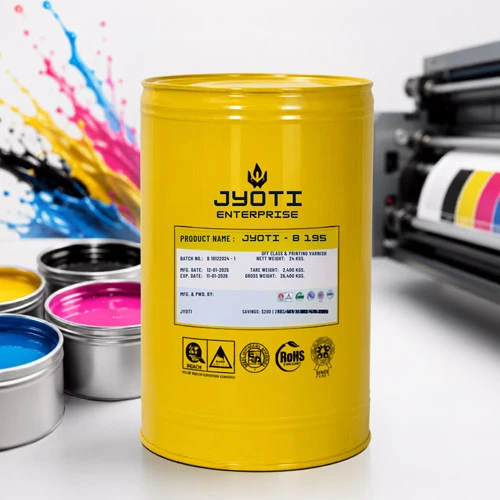
Printing Ink Reducer Manufacturer
Printing ink which has too high a viscosity will clog rollers and skip coverage; printing ink which is overly diluted will result in reduced density and print sharpness. The Printing Ink Reducer we offer is designed specially for this problem, providing a dependable means of adjusting the viscosity of your ink without reducing its color intensity.
This reducer is part of our broader printing ink support range, developed alongside our Printing Ink Reducers for flexographic, gravure, and newspaper ink applications, so it's built to work with the ink systems it's most commonly paired with.
Special Key Features
What sets a good insulating varnish apart isn't just that it dries it’s how the cured film behaves afterward. Our air drying formulations offer:
Formulated diluent suited to NC-based
Formulated diluent suited to NC-based and solvent-based printing inks
Supports smooth, consistent ink flow across
Supports smooth, consistent ink flow across offset, flexo, and gravure systems
Reduces viscosity without compromising color density
Reduces viscosity without compromising color density or print sharpness
Helps prevent clogging in rollers
Helps prevent clogging in rollers and printing equipment
Compatible with packing inks, flexographic inks,
Compatible with packing inks, flexographic inks, and gravure inks
Tested for thermal endurance and long-term
Tested for thermal endurance and long-term durability
Application Method
Printing Ink Reducer is added directly to the ink before printing begins, in small increments, with thorough stirring after each addition to reach the desired working viscosity. It's best to test print quality after each adjustment rather than adding the full estimated quantity at once, since ink systems can vary in how they respond to dilution depending on pigment load and base resin.
Ensure proper surface preparation and follow viscosity guidelines for optimal coverage and film thickness.
Specifications
Formulated as a clear, transparent diluent compatible with a range of solvent-based printing ink systems. Exact mixing ratios depend on the specific ink type and the print method being used — offset, flexo, or gravure — and are available through our technical guidance on request.
| Thermal Class | Class B (130°C), F-Class & H-Class Available |
|---|---|
| Resin Foundation | Phenolic Resin-Based Formulations |
| Curing Mechanism | Room Temperature Air Drying (Heat Optional) |
| Operating Climate | Typically 0°C to 55°C Ambient Range |
| Available Shades | Clear, Golden, Amber Shades |
Uses & Applications
This varnish range is used extensively as a finishing, impregnating, and protective coating across a wide set of electrical applications, including:
Reducing viscosity of NC-based and solvent-based
Reducing viscosity of NC-based and solvent-based printing inks
Preparing flexographic and gravure inks
Preparing flexographic and gravure inks for consistent print flow
Adjusting packing ink and general commercial
Adjusting packing ink and general commercial printing ink systems
General protective coating for industrial equipment
General protective coating for industrial equipment
General protective coating for industrial equipment
General protective coating for industrial equipment
Across all these applications, the core job stays the same — shielding sensitive electrical parts from moisture, chemical exposure, and the general wear of daily operating conditions.
Why Choose Us
Print quality depends heavily on ink consistency, and a reducer that's mismatched to the ink system can quietly undermine sharpness or color strength on the final printed surface. Our Printing Ink Reducer is formulated in conjunction with the printing inks themselves which we manufacture, providing printers with a diluent whose behavior can be predicted and not one causing unpredictability in the printing process.
The consistency of this formulation, combined with the years of solvent and coating formulations experience, makes it a useful companion to the printer in all offset, flexo, and gravure printing situations.
Trusted by Leading Names
Proven across critical applications in power, railways, defense and manufacturing: