Epoxy Compound Manufacturer
Voids inside a casting aren't just a cosmetic issue — they're weak points where moisture, thermal stress, and electrical failure can quietly take hold over time. Our Epoxy Casting Compound, built around JYOTI FIL 160 paired with Hardener 1760, is specially formulated and processed to deliver genuinely void-free casting, potting, and encapsulation for electrical and electronic components.
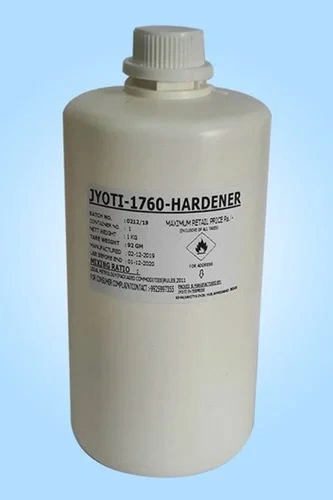
JYOTI FIL 160 is an off-white, filled, solventless epoxy compound, incorporating specially selected fillers mixed under vacuum to keep the material low in abrasiveness and low in viscosity at processing temperature. Paired with Hardener 1760, it functions as a heat-curing system suited to components where mechanical toughness and thermal performance both matter.
Special Key Features
What sets a good insulating varnish apart isn't just that it dries it’s how the cured film behaves afterward. Our air drying formulations offer:
Void-free casting result, even in complex
Void-free casting result, even in complex component geometries
Good adhesion to most organic
Good adhesion to most organic and inorganic materials
Good mechanical and electrical properties combined
Good mechanical and electrical properties combined with chemical and water resistance
Fast curing once heated
Fast curing once heated
Low coefficient of linear expansion, reducing
Low coefficient of linear expansion, reducing stress during thermal cycling
Increased thermal conductivity compared to standard
Increased thermal conductivity compared to standard casting resins
Application Method
Because JYOTI FIL 160 contains fillers that tend to settle during long storage, it should be stirred into a homogenous mixture each time it's drawn from the container. Hardener 1760 needs to be melted separately, then added to JYOTI FIL 160 while the resin is maintained at around 60-70°C, with both components mixed thoroughly. For a longer pot life, the mixed compound should be cooled to room temperature immediately after mixing.
For applications requiring additional fillers, dried, moisture-free materials like silica, talc, dolomite, or mica can be incorporated based on the performance profile needed, oven-dried at 150-200°C for 4-6 hours beforehand. Where vacuum mixing facilities are available, fillers are best added under vacuum at around 50-60°C.
Specifications
Formulated as an off-white, filled, solventless epoxy compound, suitable for Thermal Class F (155°C) electrical components when combined with Hardener 1760. The cured mass shows good thermal shock resistance, reduced shrinkage, low coefficient of thermal expansion, and increased thermal conductivity.
| Thermal Class | Class B (130°C), F-Class & H-Class Available |
|---|---|
| Resin Foundation | Phenolic Resin-Based Formulations |
| Curing Mechanism | Room Temperature Air Drying (Heat Optional) |
| Operating Climate | Typically 0°C to 55°C Ambient Range |
| Available Shades | Clear, Golden, Amber Shades |
Uses & Applications
This varnish range is used extensively as a finishing, impregnating, and protective coating across a wide set of electrical applications, including:
Casting, potting, and sealing of small
Casting, potting, and sealing of small and medium-sized electrical and electronic components
Casting switchgear components and insulators
Casting switchgear components and insulators
Potting instrument transformers
Potting instrument transformers
Applications where moderate curing temperatures offer
Applications where moderate curing temperatures offer a processing advantage
Topping capacitors as a protective sealant
Topping capacitors as a protective sealant
Across all these applications, the core job stays the same — shielding sensitive electrical parts from moisture, chemical exposure, and the general wear of daily operating conditions.
Why Choose Us
A casting compound that traps air or shrinks unevenly during cure can undermine the very component it's meant to protect, especially in switchgear and instrument transformer applications where failure isn't easily detected until it's too late. Our epoxy casting system is engineered specifically to avoid voids, reduce shrinkage, and improve thermal conductivity, giving fabricators a genuinely reliable potting solution.
That reliability is why this compound continues to be specified for electrical and electronic component encapsulation where mechanical and thermal performance both carry real consequences.
Trusted by Leading Names
Proven across critical applications in power, railways, defense and manufacturing: