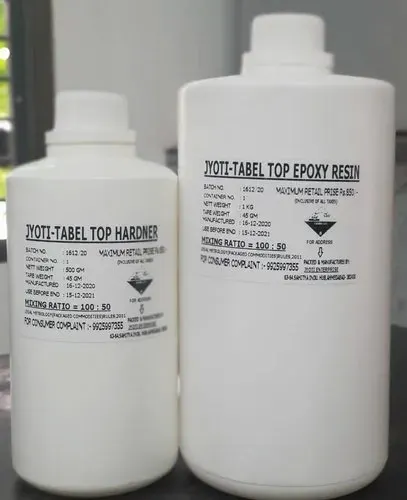
Epoxy Resin & Hardener Manufacturer
Some coating jobs don't have the luxury of an oven — a large FRP tank lining or an on-site corrosion-resistant coating needs a system that cures reliably at ambient temperature, without shrinking or losing mechanical strength along the way. Our Epoxy Resin & Hardener range is built precisely for that reality, offering a solventless, unfilled epoxy resin system that cures into a genuinely hard mass through a straightforward polyaddition reaction at room temperature.
This system combines our epoxy resin with a low-viscosity, pale yellow hardener, based on polyamines, providing a product that is not only easy to process but also mechanically durable after complete curing.
Special Key Features
What sets a good insulating varnish apart isn't just that it dries it’s how the cured film behaves afterward. Our air drying formulations offer:
Solventless, unfilled epoxy resin base
Solventless, unfilled epoxy resin base
Low-viscosity, clear polyamine hardener for easy
Low-viscosity, clear polyamine hardener for easy mixing
Curing through polyaddition reaction at room
Curing through polyaddition reaction at room temperature (20-40°C)
Good mechanical, electrical, and chemical properties
Good mechanical, electrical, and chemical properties once cured
Compatible with higher filler loading
Compatible with higher filler loading for specific performance needs
Suitable for electrical components rated
Suitable for electrical components rated at Thermal Class E (120°C)
Application Method
Resin and hardener should be mixed thoroughly at room temperature, ideally between 20°C and 40°C, and used within 30 to 40 minutes depending on ambient temperature and batch quantity, since the mixture begins hardening once combined. Tools and containers exposed to the mixture can be cleaned with Thinner 1221 before the resin sets.
For applications requiring filler loading, dried fillers like silica, talc, dolomite, or mica can be incorporated based on the performance profile needed. These fillers should be oven-dried at 150-200°C for 4-6 hours to remove residual moisture before use, and where vacuum mixing facilities are available, fillers are best added under vacuum at around 50-60°C for a cleaner mix. Moulds used for casting should be pre-treated with a mould release agent — a compound baked at 150°C for 4-6 hours and finished with a silicone paste polish tends to work best.
Specifications
Formulated as a low-viscosity system with fast curing at ambient temperature. The resin and hardener combination is suitable for electrical components rated at Thermal Class E (120°C), and the cured mass offers good mechanical, electrical, and chemical resistance properties.
| Thermal Class | Class B (130°C), F-Class & H-Class Available |
|---|---|
| Resin Foundation | Phenolic Resin-Based Formulations |
| Curing Mechanism | Room Temperature Air Drying (Heat Optional) |
| Operating Climate | Typically 0°C to 55°C Ambient Range |
| Available Shades | Clear, Golden, Amber Shades |
Uses & Applications
This varnish range is used extensively as a finishing, impregnating, and protective coating across a wide set of electrical applications, including:
A binder resin for FRP lining
A binder resin for FRP lining and FRP component manufacturing, valued for excellent chemical resistance
A corrosion-resistant finishing coat on mild
A corrosion-resistant finishing coat on mild steel and concrete structures
An insulating system for electrical components
An insulating system for electrical components requiring Class E thermal performance
General protective coating for industrial equipment
General protective coating for industrial equipment
General protective coating for industrial equipment
General protective coating for industrial equipment
Across all these applications, the core job stays the same — shielding sensitive electrical parts from moisture, chemical exposure, and the general wear of daily operating conditions.
Why Choose Us
Getting an epoxy system right isn't just about mixing resin and hardener in the correct ratio — it's about how that system behaves once fillers, temperature variation, and pot life come into play on an actual job site. Our formulations are developed with these practical realities in mind, backed by the same R&D and quality testing standards that run across our entire product range.
That reliability is why fabricators working with FRP linings, corrosion-resistant coatings, and Class E electrical components continue to specify our resin and hardener systems for demanding applications.
Trusted by Leading Names
Proven across critical applications in power, railways, defense and manufacturing: