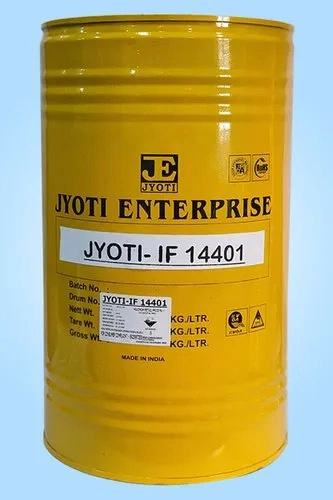
Polyurethane Resin & Hardener Dealers
Cable joints and electronic components don't get a second chance once they're sealed — the casting compound protecting them has to cure clean, stay flexible through temperature swings, and hold its bond for years underground or inside a switchgear cabinet. Our Polyurethane Resin & Hardener system, built around JYOTI 14401 paired with Hardener 1200, is engineered specifically for that kind of long-term, no-margin-for-error application.
JYOTI 14401 is a filled, solventless, reddish-brown resin, combined with Hardener 1200, an aromatic isocyanate. Together, they cure through a polyaddition reaction at room temperature into a flexible, stress-free cured mass — a meaningfully different outcome from a rigid, brittle cast that could crack under thermal cycling.
Special Key Features
What sets a good insulating varnish apart isn't just that it dries it’s how the cured film behaves afterward. Our air drying formulations offer:
Two-component, room-temperature curing polyurethane casting system
Two-component, room-temperature curing polyurethane casting system
Cures with low volume shrinkage
Cures with low volume shrinkage and low exotherm for a stress-free mass
Flexible cured film with excellent temperature
Flexible cured film with excellent temperature cycling behavior
Good resistance to electrical tracking
Good resistance to electrical tracking
Improved adhesion specifically to cross-linked polyethylene
Improved adhesion specifically to cross-linked polyethylene (XLPE) cables
Suitable for electrical components operating up
Suitable for electrical components operating up to 120°C (Class E)
Application Method
Before mixing, the resin component (JYOTI 14401) should be stirred well, since the filler content tends to settle during long storage. Once stirred, JYOTI 14401 and Hardener 1200 are mixed in the recommended proportion at room temperature (20-40°C) and used for casting or potting within the pot life of the mixture. Because this is a fast-reactive system, pot life is genuinely limited, so it's best to mix only what can be applied within that working window.
Ensure proper surface preparation and follow viscosity guidelines for optimal coverage and film thickness.
Specifications
Formulated as a two-component, solventless polyurethane casting resin system, suitable for electrical components rated up to 120°C (Class E). The cured mass is flexible, with low shrinkage, low exotherm, and good resistance to tracking. Exact mixing ratios and pot life details are available through our technical data sheets.
| Thermal Class | Class B (130°C), F-Class & H-Class Available |
|---|---|
| Resin Foundation | Phenolic Resin-Based Formulations |
| Curing Mechanism | Room Temperature Air Drying (Heat Optional) |
| Operating Climate | Typically 0°C to 55°C Ambient Range |
| Available Shades | Clear, Golden, Amber Shades |
Uses & Applications
This varnish range is used extensively as a finishing, impregnating, and protective coating across a wide set of electrical applications, including:
Casting, potting, and encapsulation of electrical
Casting, potting, and encapsulation of electrical and electronic components
Sealing cable joints on both low
Sealing cable joints on both low and high voltage cables
Applications involving cross-linked polyethylene (XLPE) cables,
Applications involving cross-linked polyethylene (XLPE) cables, where adhesion is critical
Components requiring flexibility through repeated temperature
Components requiring flexibility through repeated temperature cycling
General protective coating for industrial equipment
General protective coating for industrial equipment
Across all these applications, the core job stays the same — shielding sensitive electrical parts from moisture, chemical exposure, and the general wear of daily operating conditions.
Why Choose Us
A casting resin that shrinks too much, generates too much heat while curing, or cracks under thermal cycling can compromise the very component it's meant to protect. Our polyurethane system is formulated specifically to avoid those failure points — low shrinkage, low exotherm, and a flexible final cure that holds up to real-world temperature swings, not just lab conditions.
That reliability is why this system continues to be specified for cable joint sealing and electronic component encapsulation, where a failure isn't just inconvenient, it's often expensive and hard to access once installed.
Trusted by Leading Names
Proven across critical applications in power, railways, defense and manufacturing: