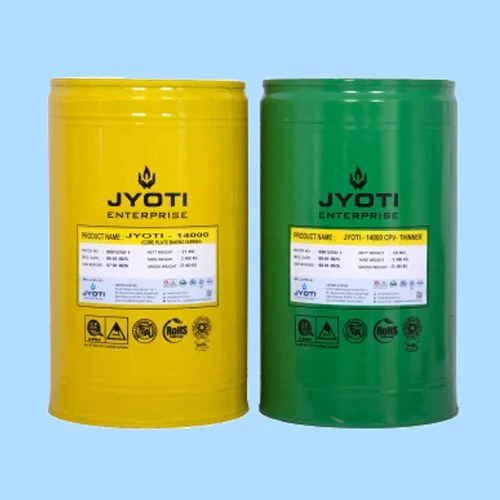
Baking Thinner Supplier
Baking varnishes go through an oven cycle that air-dry varnishes never see, and the solvent system needs to hold up through that heat without leaving residual trapped solvent or softening the wire underneath. Our Baking Thinner range, including grades like JYOTI 151 Thinner, is formulated using selected organic solvents specifically matched to our baking impregnating varnish grades.
In contrast to being an afterthought, each thinner in this series is created in conjunction with the particular varnish it is designed to reduce, such that the evaporative characteristics of the thinner are synchronized with the curing of the varnish in the oven.
Special Key Features
What sets a good insulating varnish apart isn't just that it dries it’s how the cured film behaves afterward. Our air drying formulations offer:
Formulated using selected organic solvents matched
Formulated using selected organic solvents matched to baking varnish grades
Does not soften enamelled wire during
Does not soften enamelled wire during application or bake cycle
Evaporates before the varnish film begins
Evaporates before the varnish film begins gelling, reducing solvent entrapment
Suggested specifically for viscosity reduction ahead
Suggested specifically for viscosity reduction ahead of dipping or VPI application
Matched to corresponding baking varnish products
Matched to corresponding baking varnish products for reliable performance
Tested for thermal endurance and long-term
Tested for thermal endurance and long-term durability
Application Method
Baking Thinner should be added to the varnish under constant stirring, which helps prevent the varnish's constituents from separating during the mixing process. The right quantity depends on the target viscosity needed for the specific application method, whether that's dipping or vacuum pressure impregnation, and on the winding geometry involved.
Because this thinner is engineered to evaporate ahead of the varnish film gelling, there's a reduced chance of solvent becoming trapped once the component goes through its bake cycle — a detail that matters considerably more for baked varnishes than air-dried ones, since trapped solvent can affect the film's bonding and thermal performance.
Specifications
Formulated as an organic solvent-based thinner, matched to specific baking varnish grades such as JYOTI 151. Exact mixing ratios depend on the target viscosity and the varnish product being thinned.
| Thermal Class | Class B (130°C), F-Class & H-Class Available |
|---|---|
| Resin Foundation | Phenolic Resin-Based Formulations |
| Curing Mechanism | Room Temperature Air Drying (Heat Optional) |
| Operating Climate | Typically 0°C to 55°C Ambient Range |
| Available Shades | Clear, Golden, Amber Shades |
Uses & Applications
This varnish range is used extensively as a finishing, impregnating, and protective coating across a wide set of electrical applications, including:
Reducing viscosity of matched baking impregnating
Reducing viscosity of matched baking impregnating varnish grades
Preparing varnish for dip or vacuum
Preparing varnish for dip or vacuum pressure impregnation (VPI) application
Restoring proper viscosity to baking varnish
Restoring proper viscosity to baking varnish that has thickened during storage
General protective coating for industrial equipment
General protective coating for industrial equipment
General protective coating for industrial equipment
General protective coating for industrial equipment
Across all these applications, the core job stays the same — shielding sensitive electrical parts from moisture, chemical exposure, and the general wear of daily operating conditions.
Why Choose Us
Whereas the thinner used to spread the varnish fails to evaporate effectively before the start of the bake cycle, there remains solvent within the dried film of the coating. In our line of baking thinner products, the products are designed precisely with respect to the varnish grades they are used for.
Such consideration helps in making sure that the performance of the baking varnish coating is not compromised in any way.
Trusted by Leading Names
Proven across critical applications in power, railways, defense and manufacturing: